
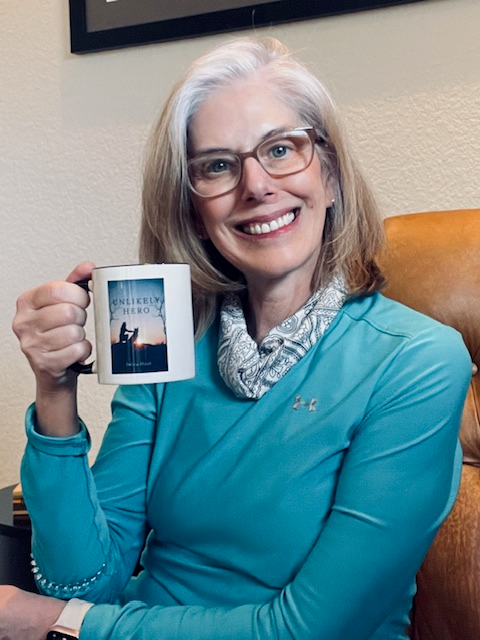
Name/pen name: Debra Hunt (goes by Debbie with friends/family)
Location: Colorado Springs, CO
Genres: Women’s Fiction with suspense elements, book club fiction
DO YOU HAVE A PARTICULAR WRITING RITUAL WHEN YOU SIT DOWN TO WORK? IF SO, DESCRIBE IT.
I have a strong procrastination ritual, and I need to exercise extreme discipline or I’ll sabotage myself with the most inane “must-do” task on my way to my desk — and it goes without saying that the desk itself must be tidy before a single word gets written.
Once I finally sit down, I have Alexa play soothing classical music and I light a candle. If I’ve been writing consistently and the details of my characters are fresh, I can find a rhythm fairly easily — though I wouldn’t go so far as to call it “flow.” That’s rare for me.
I write scene by scene, and it helps to ask myself: how does this scene move the story forward, or change the characters? I’ve also noticed procrastination within the writing itself. When I’m nervous about a pivotal moment, I’ll write all manner of minor details and tangents — a warm-up, really, to what actually needs to happen. The inner critic is still bossing me around in those moments. My saving grace is knowing, from interacting with all manner of writers, that I am not alone in this.
If a session is going well and there’s no hard deadline, I can write for up to two hours. I always go back and correct the worst typos before saving — I’m a poor typist — and I compulsively check the word count and add new scenes to a document I call “the whole shebang.” If I’m feeling particularly compulsive, I’ll print the latest pages and save everything in multiple locations, just in case the computer or the cloud betrays me. I feel a little like Jack Nicholson in As Good as It Gets with these self-soothing rituals — but they’re mine, and they work.
DO YOU WRITE WANT YOU THINK READERS WANT OR DO YOU TEND TO BE ORIGINAL AND WRITE WHAT YOU ENJOY, CONFIDENT YOUR IDEAL READERS WILL FIND YOU?
I came to publishing fiction somewhat late in life, as a natural extension of my love of reading and writing. I draw from lived experience to generate ideas, then weave in enough craft and familiar tropes to shape a story I hope will resonate with others. It’s an instinct more than a strategy — I write what moves me and trust that the right readers will find it.
My first book began with a single question: what would a protection dog do if asked to defend his owner against an attack by his own trainer? My current work explores something equally close to my heart — middle-aged women reprising a teenage scheme to embark on an iconic road trip. I shared the idea with my hairstylist, and she said, without hesitation, “I’d read that.” A focus group of one — and that was all it took to commit to turning one idle thought into a modern-day hero’s journey.
I suppose the honest answer is that I write for myself first, and trust my ideal readers are out there looking for exactly this.
DO YOU BELONG TO ANY WRITERS’ GROUPS? ANY WRITING ORGANIZATIONS? OR DO YOU PREFER TO GO IT ALONE?
I’m at a slight disadvantage since I moved to Colorado Springs about two years ago at the same time as I started my journey to published author in earnest.
Last year I gained enormous confidence from the Resilient Writers structured coaching program. The consistency, the coaching, and the method really clicked for me — it was exactly the scaffolding I needed at that stage.
I try to be judicious about what I join and subscribe to, because the marketing noise directed at writers can be intense and overwhelming. How do you choose from literally hundreds of offers? Recently I joined Women in Publishing Society, a virtual group, to take advantage of its networking and knowledge-sharing opportunities.
I’m also a member of Pikes Peak Writers, a regional organization here in Colorado Springs, and I’m attending my first conference with them at the end of this week. I’m excited to find kindred spirits writing in my genre — people I can trade critiques with, commiserate with, and learn from. After going it largely alone through my first launch season, I’m ready for some community.
NAME YOUR 3 FAVORITE AUTHORS OR YOUR 3 FAVORITE BOOKS? HOW DID THEY INFLUENCE YOU AS A WRITER?
I have long admired John Irving, Jodi Picoult, and Anna Quindlen. Irving taught me that a story can be both deeply tender and quietly devastating — The Cider House Rules and A Widow for One Year showed me how much emotional weight fiction can carry without ever becoming sentimental. Picoult demonstrated that you could tackle difficult, morally complex subjects and still write a page-turner. And Quindlen’s ability to render ordinary women’s lives with dignity and precision is something I aspire to in my own work.
More recently I’ve been inspired by Bonnie Garmus’s Lessons in Chemistry and Shelley Read’s Go as a River — both are stories centered on women of quiet resilience, which is very much the territory I want to inhabit as a writer.
I learn something from every book I read, and lately I’ve started watching television differently too — noticing dialogue conventions, tropes, and subplot architecture in a way I simply didn’t before I began thinking seriously about craft. Story is everywhere, once you start looking.
IF YOU COULD TELL YOUR YOUNGER WRITER SELF ANYTHING, WHAT WOULD IT BE?
I was always drawn to writing and imagined I’d have a career as a journalist — with teaching language arts as my fallback. Neither came to pass, but I never stopped finding ways to write in whatever work I did. Like the character Sybil in The Correspondent, I’ve always preferred writing to speaking; it’s simply how I’m wired.
What I’d tell my younger self is this: ignore the fear and self-doubt, claim the identity of fiction writer — not someday, but now — and build a writing ritual that protects the work. What did Malcolm Gladwell say in Outliers — something about needing 10,000 hours of practice to truly master a skill? I think about that a lot. If I had invested those hours in fiction writing earlier, I would have honed my craft far sooner — and it wouldn’t feel like such a hard-won battle now.
WHAT DOES AUTHOR SUCCESS LOOK LIKE FOR YOU?
I have surpassed my once-amorphous goal of seeing my name on the spine of a published book. Oddly, the heavens haven’t opened and showered me in glory and self-satisfaction — and even more oddly, I find I have another story to tell, and I’m not afraid it won’t be good enough.
Moving forward, my goals are to keep producing and marketing women’s fiction, to build a reputation as a writer of authenticity, and to use my platform to encourage others to act on their own dreams. Because tomorrow isn’t guaranteed — and someday needs to be now.
HOW DO YOU BALANCE WRITING, REVISING, EDITING, MARKETING, AND SOCIAL MEDIA? ANY TIPS YOU’D LIKE TO SHARE?
In my first launch season, I’ll be honest — I don’t balance it, at least not yet. I keep telling myself to focus on one aspect of the process at a time, in short dedicated sessions, but right now nearly all my energy has gone toward marketing. I have to remind myself that I came to this at a different stage of life than someone launching a first career, which changes the calculus entirely.
Social media is not always a natural fit for me, and I’m quite sure my efforts don’t satisfy the algorithms. Translation: I find it discouraging, overwhelming, and — occasionally — profanity-inducing.
What I’m learning to do instead is lean into organic opportunities: local events, friends willing to share my work, and more recently, networking with other women in the industry to earn the next open door. These feel authentic in a way that chasing engagement metrics simply doesn’t.
I’m also wistful for the season when I was only drafting, or only revising — that singular focus felt like a gift I didn’t fully appreciate at the time. My best advice? Give yourself permission to do one thing well rather than five things badly. The work is what lasts. Everything else is in service of it.
HAVE YOU EVER HIDDEN SOMETHING TRUE INSIDE A WORK OF FICTION. WHY, OR WHY NOT?
Anyone who knows me, the town where I spent my youth, and my deep appreciation for companion animals would be nodding their heads knowingly right now. I draw heavily on lived experience, but as in dreams, characters and events are mixed and matched. The story is fiction, but the characters are imbued with my own beliefs, hopes, and fears.
That’s the delicious thing about fiction — you can play with “what if” on the page, work out your own angst, and no one really gets hurt. Some writers might object, but I’ll own it: there’s a deeply therapeutic aspect to my writing, and I wouldn’t have it any other way.
WHERE DO YOU SEE YOURSELF IN 5 YEARS?
In five years, I will still be writing, editing, and marketing — but the pitch, the readings, the signing events will feel less like hurdles and more like home. I’ll be more comfortable circulating among my peers, both locally and in the virtual spaces where writers gather.
I’ve created a self-publishing imprint, Seven Secrets Press, to give myself the freedom to bring my second novel into the world — so my signing table will have two books on it instead of one. After that, I hope to master the art of memoir, weaving together milestone stories from my grandmother’s life and my own into something that honors us both.
The more I write, the more ideas surface. Ultimately, I’d love to lead workshops that help creative people find fulfillment in later life by finally acting on their long-held dreams — because as I’ve learned, tomorrow isn’t guaranteed, and someday needs to be now.
And lastly, maybe by then I will have stopped putting two spaces after every period. But I can’t guarantee that!
WEBSITE:
www.debrahunt.com
WHERE TO BUY YOUR BOOKS:
Unlikely Hero is distributed to many retail outlets by Ingram. I would love it if readers asked for it at their favorite indie bookstore (the shop keeper can easily order it). Alternatively, readers can order it from major online outlets such as Amazon https://a.co/d/0aANoGyZ and Barnes & Noble https://www.barnesandnoble.com/w/unlikely-hero-debra-hunt/1149575693