
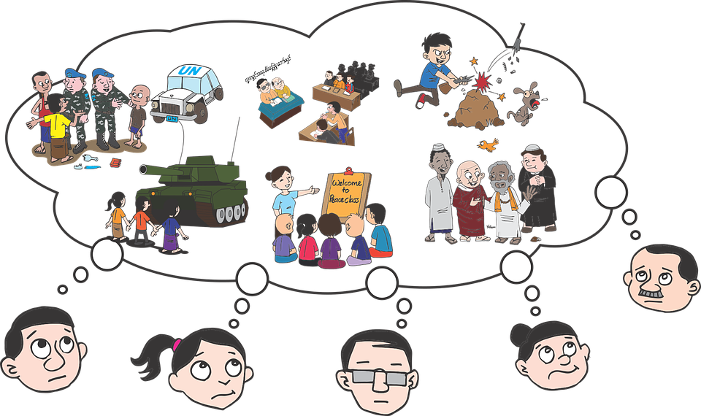
In this final part of my blog series on literary elements I address when writing a novel, I will focus on conflict.
Every story needs conflict or else there really isn’t anything to drive the story. As in our lives, our characters must face both internal and external conflicts.
Internal Conflict: a struggle within yourself. It could be a moral dilemma, it could be want versus need, or an internal debate between two choices. Internal conflict is a character versus themself.
Character versus self: The title character in Shakespeare’s Hamlet, Pip from Great Expectations, Rowling’s Harry Potter and Frodo from The Lord of the Rings.
External Conflict: a struggle with outside forces. The most used external conflicts can be a character versus another character, a character versus nature, a character versus society, a character versus technology and a character versus the supernatural and even a character versus God (or a higher power).
Some examples from literature include:
Character versus another character: Elizabeth Bennet and Mr. Darcy (Pride and Prejudice), Sherlock Holmes and Professor Moriarty and Harry Potter and Voldemort.
Character versus nature: Robinson Crusoe, Pi Patel (Life of Pi), The Perfect Storm and Jaws.
Character versus society: Katniss Everdeen (The Hunger Games), Offred (The Handmaid’s Tale) and Atticus Finch (To Kill a Mockingbird).
Character versus technology: Frankenstein, 2001: A Space Odyssey, William (by Mason Coile).
Character versus the supernatural: The Haunting of Hill House, Macbeth, Harry Potter series.
Character versus God: Jean Valjean (Les Miserables), The Odyssey by Homer and Oedipus Rex.
Whatever the conflict, the obstacle the character faces is something specific to them and their journey. The conflict shouldn’t be easy to solve and should challenge the character in a real struggle. Every character has their own set of beliefs, their own wants and goals, which shape how they will act and react to these obstacles.
A full character arc will not only show their physical journey, but also how they have changed and/or adapted to this new worldview after facing these obstacles. Remember, not every character will grow and change for the better. For some, there may be a negative change as a result of everything they will go through.
Obviously, without conflicts and challenges, stories would be very boring, so the result should be entertainment and engagement with your readers.
On a personal note: I write suspense/thrillers and light horror, so conflict drives the suspense and tension necessary to keep the story moving forward. The conflict in these genres needs to build, driving the plot and keeping the reader turning the pages. But even in a genre like romance, there still has to be conflict. What obstacles do the couple wanting to be together face? Maybe it’s their personal beliefs that are so different. Maybe it’s family interference.
So conflict drives the story, engages the reader and gives the characters purpose, revealing their strengths, weaknesses and motivations.
Without conflict, it just isn’t a story. That being said, there are always exceptions like The Mezzanine by Nicholson Baker and All Creatures Great and Small by James Herriot.